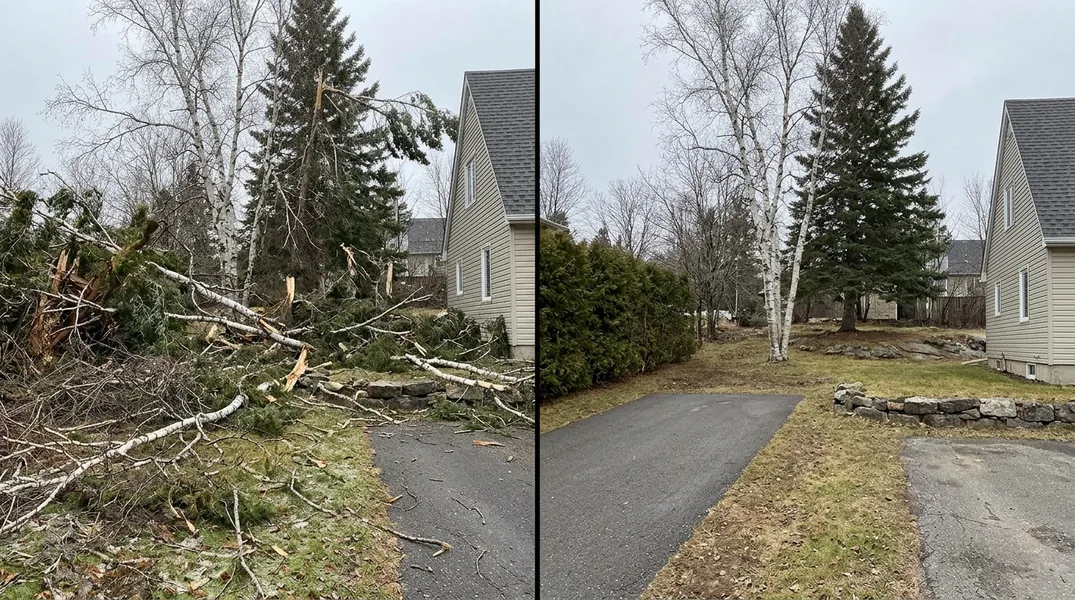
Why Thunder Bay Trees Grow on Shallow Roots
Much of Thunder Bay sits on the Canadian Shield, where the soil layer over bedrock is often only a few centimetres deep. In those conditions, trees cannot send a deep taproot down for anchorage. Instead, they spread a wide, plate-like root system just below the surface, weaving through cracks in the rock and the thin organic layer above it. That strategy works well in calm weather, but it leaves the tree far more exposed to wind than a deep-rooted species would be.
Homeowners in Northwood (Thunder Bay) and other rocky neighbourhoods often notice this first after a storm, when a spruce or birch that looked healthy for decades suddenly tips over with a surprisingly small root plate. The roots were never deep, they were simply wide, and once the soil around them loosens or the crown catches too much wind, the whole tree can rotate at the base. Understanding this is the first step in judging whether a tree on your lot is a genuine hazard.
Lake Superior Winds and the Windthrow Risk in Thunder Bay
Lake Superior generates strong, sustained winds that funnel across the city, especially along the waterfront and on exposed ridges. Combined with shallow roots on bedrock, those winds create a real windthrow risk in Thunder Bay. A tree that leans after a windstorm is often showing the first sign that its root plate has begun to lift, and a leaning tree in Thunder Bay should never be ignored, even if it has leaned that way for years. The lean can accelerate quickly once the soil is saturated by rain or spring melt.
Species matters too. Spruce and birch, common across the region, have shallow, spreading roots and are more prone to tipping on rocky ground. Maple and oak tend to hold better, but they still fail when their crowns are unbalanced or when deadwood adds weight and wind resistance. Our crews routinely assess Tree Pruning needs on exposed lots, because thinning a dense crown reduces the sail area that wind pushes against. Where a valuable tree shows early instability, tree cabling and bracing can sometimes add support, though removal is the safer choice when the root plate is already compromised.
What a Tree Stability Assessment Actually Checks
A tree stability assessment is not a guess. An ISA Certified Arborist looks at the root flare for signs of lifting or fungal decay, checks the soil for cracks and heaving, and evaluates the lean against the prevailing wind direction. The crown is inspected for unbalanced weight, co-dominant stems and deadwood that increases wind load. On rocky lots, the arborist also notes how much soil actually covers the bedrock, since a tree rooted in a thin pocket of soil behaves very differently from one in a deeper ravine lot.
If a tree is close to a house, a driveway or a hydro service, the assessment carries extra weight. Our team documents the findings clearly so you can make an informed decision, and we can provide an arborist report when the City of Thunder Bay requires one for a private tree removal. That report supports the permit application and gives you a written record of the risk. If removal is the right call, our Tree Removal service is planned around the site conditions, including tight access between rock outcrops and structures.
Caring for Trees on Rocky Soil
Trees on bedrock need a different approach to care than trees in deep garden soil. Water runs off quickly, so drought stress shows up sooner in summer, and roots are more easily damaged by grading, paving or storage of heavy equipment. Keeping a mulch ring around the trunk helps retain moisture and moderates soil temperature, but piling mulch against the bark invites decay. Avoid driving over the root zone, since shallow roots are close to the surface and compact easily.
Regular Tree Trimming keeps the crown balanced and removes deadwood before it becomes a wind hazard. Where a tree has already been lost, Stump Grinding clears the stump and surface roots so the site can be replanted or used safely. For a clear picture of what this work costs in your neighbourhood, see our rates page, and call (807) 699-7871 if you would like a free estimate on a specific tree.
When to Call for Help in Thunder Bay
Not every lean means a tree must come down, but some signs should prompt a call. A new lean after a windstorm, soil cracking or lifting at the base, mushrooms or conks near the root flare, and dead branches over a roof are all reasons to have a tree looked at promptly. In Westfort (Thunder Bay) and other older neighbourhoods, mature trees near homes and hydro service lines are especially worth checking after a storm.
Thunder Bay Tree Trimming Co. is a local, fully insured company serving homeowners across the city. Our ISA Certified Arborists can assess tree stability, plan safe removals and handle pruning that reduces wind risk. For work near hydro lines, we limit ourselves to clearance around your private service entrance, the wire from the pole to your house, and we respect the required approach distances. Call (807) 699-7871 or request a free quote to have your trees assessed before the next big blow.
Looking for a professional in Thunder Bay? Thunder Bay Tree Trimming Co. responds quickly for all your tree trimming needs.
Get a free estimateOur services : Tree Trimming · Tree Removal · Stump Grinding