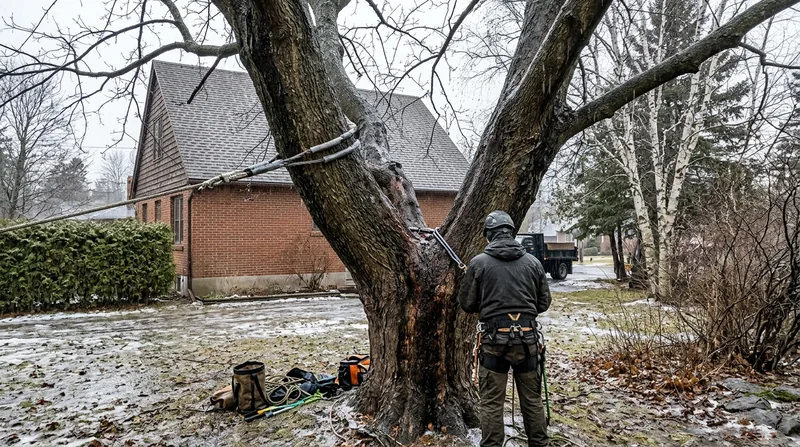




When a mature maple or oak in your yard develops a split fork or a cracked limb, removal is not always the answer. Tree cabling and bracing in Thunder Bay gives sound trees a second life by installing flexible cables and steel rods that hold weak unions together through wind, snow and ice. Our ISA Certified Arborists inspect the tree first, because hardware only helps when the wood is still solid and the defect is mechanical rather than a sign of decay. Across the Thunder Bay area, from Westfort to Northwood, we see the same pattern: post-war street trees and ravine-lot hardwoods that have grown large enough to fail at a narrow crotch. We install the system, document it and tell you honestly when a tree is past saving and should come down instead. For the removal side of that decision, see our tree removal service.
Why cabling and bracing matter on mature trees
A tree with a tight V-shaped fork or two co-dominant leaders carries a built-in weak point. As the canopy fills with snow or catches a summer windstorm, the two stems push apart and the bark cracks at the union. Cabling does not heal the tree, but it limits how far the leaders can move, which is often enough to keep a valuable shade tree standing for many more years.
- We inspect the fork, the root flare and the canopy before recommending any hardware.
- We install flexible steel cables high in the crown to share the load between two or more leaders.
- We use through-rods where a split has already started and the union needs direct support.
- We record the installation with photos and a written note so the work can be checked later.
Every installation starts with a load assessment, because a cable placed in a decaying tree only delays a hazard. If the inspection shows advanced decay, we say so and explain the alternatives.
Key fact: a single cable and rod installation in Thunder Bay typically runs from $450 to $900 depending on tree height, number of leaders and access. A large silver maple over a driveway in Fort William with three co-dominant stems can reach $1,200 once two cables and a rod are needed.
The International Society of Arboriculture publishes guidance on support systems and tree risk assessment at isa-arbor.com, which is the reference our arborists follow when deciding whether hardware is appropriate.
How we install a cable or brace
The process is deliberate because the hardware has to last for years and the tree has to keep growing around it. We plan the height of the cable, the direction of the pull and the hardware size before anyone climbs. On ravine lots with steep access, the rigging plan also covers how the crew and equipment reach the tree safely.
- We walk the property with you and identify the defect, the targets below and the species involved.
- We assess the wood with a sounding mallet and, where needed, a resistance drill to confirm the fork is sound.
- We set the cable height at roughly two-thirds of the distance from the defect to the top of the canopy.
- We drill and install the hardware, tension the cable and check that both leaders move together under load.
- We prune deadwood around the installation so the cable is not abraded by rubbing branches.
- We leave you a written record and recommend a re-inspection interval.
Most jobs are completed in a single visit, and the tree is left tidy with all cuttings chipped and removed. If the canopy also needs thinning to reduce wind load, we handle that in the same climb through our tree pruning service.
Key fact: on a Norway spruce in Gillies with two leaders splitting at 6 metres, we installed one 8 mm cable at 11 metres and removed 40 kg of deadwood from the crown. The homeowner avoided removing a tree that shades the entire back lawn.
Support methods compared
Not every weak tree needs the same hardware. The choice depends on the defect, the species and what sits underneath the canopy. The table below shows the options we use most often across the Thunder Bay area.
| Method | Description | Context |
|---|---|---|
| Flexible steel cable | A stranded cable anchored in two or more leaders, tensioned to limit spread. | Co-dominant stems on maple, oak and ash with no visible decay. |
| Through-rod | A steel rod passed through the union and capped on both sides. | A fork that has already split or cracked after an ice storm. |
| Cable and rod combined | A rod stabilizes the union while a cable shares load higher in the crown. | Large mature trees over driveways, roofs or play areas. |
| Lightning protection | A copper conductor from the top of the tree to a ground rod. | Specimen trees on open lots where storms are frequent. |
We recommend the lightest system that solves the problem, because every piece of hardware is a long-term commitment for the tree.
Permits, clearance and cleanup
Cabling and bracing is a preservation treatment, so it rarely triggers a removal permit. The City of Thunder Bay may require a permit for a private tree removal, and an arborist report normally supports that application, but keeping a tree standing through hardware usually avoids the process. Rules and thresholds differ from one municipality to the next across the Thunder Bay area, so we confirm the local requirement before any work begins.
Near private electrical service entrances, we respect the required approach distances and never touch the public distribution network operated by your local utility or Hydro One. If a limb is touching the service line to your house, we coordinate with you and the utility before climbing. All cuttings are chipped on site and the chips can be left with you or hauled away; our brush chipping service covers larger volumes from storm-damaged crowns.
If the inspection shows the tree cannot be saved, we explain the findings and, where the municipality requires it, prepare the documentation through our arborist report service. You get a clear recommendation either way, with no pressure to choose hardware when removal is the safer option.
What the work costs and how to plan it
Pricing depends on tree height, the number of leaders to support, the hardware required and access to the canopy. A single cable on a backyard tree reachable through a standard gate sits at the low end, while a multi-leader installation over a roof or driveway sits at the high end. We confirm the scope on site and give you a written figure before the crew climbs.
Our pricing page outlines the range for support systems and related pruning work. If you are comparing options, the inspection tells you whether hardware, pruning or removal is the right call, and we put that in writing so you can decide without guesswork. Call (807) 699-7871 to book a free estimate in Thunder Bay, Oliver Paipoonge or Gillies.
Prices Tree Cabling & Bracing in Thunder Bay — Indicative pricing
| Service | Price | Details |
|---|---|---|
| Single cable installation | From $450 | One flexible cable in a co-dominant fork, inspection and cleanup included |
| Cable and rod combination | From $750 | Rod through a split union plus a cable higher in the crown |
| Multi-leader support (3+ stems) | From $1,200 | Two or more cables and rods on a large mature tree |
| Re-inspection and tension adjustment | From $175 | Check hardware, adjust tension and document condition |
| Travel | Included | In Thunder Bay and the surrounding area |
| Estimate | Free | Reply within 24 hours at (807) 699-7871 |
Indicative prices; free, personalized estimate within 24h at (807) 699-7871.