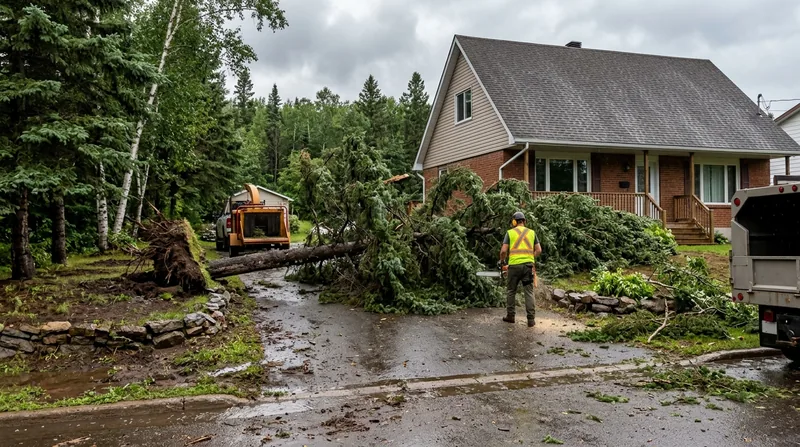




Emergency tree removal in Thunder Bay starts with a phone call and a crew that knows what a northern storm can do to a mature maple or a spruce leaning over a roof. Ice storms off Lake Superior, summer windstorms, and saturated in Thunder Bay and the surrounding area clay all bring trees down fast, and the damage rarely waits for business hours. We are a local, fully insured company with ISA Certified Arborists on staff, and we have handled storm calls across Thunder Bay since 2020. Our job is to stabilize the situation, remove the hazard safely, and document the damage for your insurer. If a tree is already down or split, call (807) 699-7871 and we will tell you what to do before we arrive. For non-urgent work, our storm damage cleanup service covers the broader aftermath.
Why a downed tree cannot wait in Thunder Bay
A tree that has fallen on a house, a vehicle, a fence or a driveway is an active hazard, not a landscaping problem. Weight shifts, cracked trunks can split further, and a limb under tension can release without warning. In the Thunder Bay area, mature street trees in post-war subdivisions and ravine lots with steep access make each call different, and the first hour matters. We treat every call as urgent until an ISA Certified Arborist has assessed the tree on site.
- A tree resting on a roof can compromise shingles and structure with every gust.
- A split trunk under tension may release a limb without warning.
- A blocked driveway prevents access for emergency vehicles and family cars.
- A leaning tree near a private service entrance needs assessment before anyone approaches.
- A downed tree across a fence line can pull posts and damage neighbouring property.
Each of these situations is stabilized first, then cleared, so the property is safe before any cleanup begins.
Key fact: A summer windstorm that hits a mature silver maple in Westfort can drop a limb of 2 to 4 metres across a driveway in minutes. Crews that arrive with the right rigging and a chipper clear that kind of call in a single visit, while an unprepared crew often needs two.
For the safety rules that apply to trees near private electrical service entrances, see the Electrical Safety Authority guidance on approach distances.
How our crews handle an emergency call
Every emergency call follows the same sequence, whether the tree is on a house in Northwood or across a lane in Oliver Paipoonge. We ask a few questions on the phone, dispatch the closest crew, and secure the site before any cutting starts. The arborist on site decides whether the tree can be removed in sections or must be taken down in one piece with rigging.
- We take your call and record the address, the type of tree and what it has hit.
- We advise you to keep people and pets away from the tree and not to touch anything near a private service entrance.
- Our crew arrives, assesses the tree and secures the area with cones and barriers.
- We remove the hazard in controlled sections, using rigging where the tree is under tension.
- We chip the brush, cut the wood to your preferred length and clear the debris.
- We photograph the damage and provide a written summary for your insurer.
The site is left safe and clear, and you receive a record of what was removed and why.
Key fact: A black locust that splits over a garage in Gillies often needs rigging rather than a straight felling cut. The wood is dense and the hinge behaves differently from maple, so the arborist adjusts the cut and the pull line before any saw goes in.
If the tree is still standing but unstable, our tree removal service covers planned takedowns with the same rigging approach.
Removal methods we use on emergency calls
The method depends on where the tree has landed, how much tension is in the wood and how much room the crew has to work. A tree on an open lawn is handled differently from one wedged against a house or tangled in a fence. The table below shows the main approaches and when each one applies.
| Method | Description | Context |
|---|---|---|
| Sectional rigging | The crew lowers limbs and trunk sections on ropes to control the fall. | Tree on a roof, over a fence or close to a private service entrance. |
| Controlled felling | The tree is cut at the base and guided to a clear drop zone. | Open yard or lot with enough room and no structures in the path. |
| Limb removal under tension | The crew relieves pressure on a split or pinned limb before cutting. | Tree leaning on a vehicle, a fence or another tree. |
| Hand cutting and chipping | Small debris is cut down and fed through the chipper on site. | Brush, branches and tops after the main hazard is down. |
The arborist confirms the method on site, and the crew switches approach if conditions change during the work.
Permits, safety distances and debris in the Thunder Bay area
Emergency work still follows local rules. The City of Thunder Bay may require a permit for a private tree removal, and the application is normally supported by an arborist report. Rules and thresholds differ from one municipality to the next across the Thunder Bay area, so we check before we cut whenever the tree is not an immediate hazard. Approach distances must be respected near private electrical service entrances. The public distribution network of your local utility or Hydro One is never touched by our crews; a tree touching the public lines is referred to your local utility or Hydro One.
Debris is handled on site. Brush goes through the chipper, wood is cut to length and stacked or removed at your request, and the ground is raked where the tree came down. If you need the wood kept, our firewood service can cut and split it to the size you burn. When a permit or report is needed, our arborist report service documents the tree and supports the application.
Key fact: A removal in Northwood that requires a permit can be documented the same week, while an emergency call where the tree is already on a structure is stabilized first and the paperwork follows. The order changes, but the documentation is always produced.
What the call-out involves, from first ring to final cleanup
Most emergency calls are resolved in a single visit, but the timing depends on the tree, the access and the damage. A limb on a driveway in Thunder Bay is often cleared within a couple of hours, while a large spruce on a roof in Oliver Paipoonge can take most of a day. We tell you on the phone what to expect and update you when the crew is on the way.
- The crew confirms the scope on arrival and photographs the damage before cutting.
- Rigging is set where the tree is under tension or close to a structure.
- The hazard is removed in sections, with the drop zone controlled at all times.
- Brush is chipped and the wood is cut to length or removed.
- The site is raked and left clear, and the damage record is sent to you.
The result is a safe property and a written record you can pass to your insurer.
For planning and budgeting, our pricing page sets out how emergency calls are quoted, and our contact page is the fastest way to send photos before a crew is dispatched.
Prices Emergency Tree Removal in Thunder Bay — Indicative pricing
| Service | Price | Details |
|---|---|---|
| Limb or small tree down | From $275 | Limb on a driveway, fence or lawn, cleared and chipped |
| Tree on a roof or vehicle | From $850 | Rigging and sectional removal, damage documented for your insurer |
| Large tree, tight access | From $1,500 | Backyard reachable only through a standard gate, rigged in sections |
| Storm call-out after hours | Quoted on site | Assessment and stabilization, free estimate before work |
| Travel | Included | In Thunder Bay and the surrounding municipalities |
| Estimate | Free | Call (807) 699-7871, response within 24 hours |
Indicative prices; free, personalized estimate within 24h at (807) 699-7871.