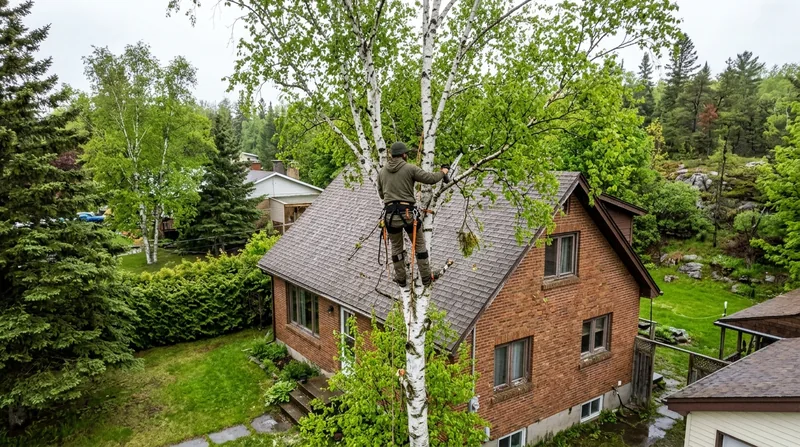




Homeowners across Thunder Bay deal with a specific set of tree problems: silver and sugar maples that drop heavy limbs over driveways, red and white oaks crowding rooflines, ash trees weakened by the emerald ash borer, and cedar hedges that mark almost every property line. Tree trimming in Thunder Bay keeps those trees healthy and keeps your house, your vehicle and your family out of harm's way. Our crews follow good arboricultural standards on every job: we remove crossing, low and overextended limbs, lift crowns clear of roofs, driveways and lawns, and shape each tree for balance. We are a local, fully insured company, and we have been working the Thunder Bay area since 2020 with ISA Certified Arborists on staff. If you are comparing two or three companies, start with a look at our pricing page so you know what a fair number looks like.
Why trimming matters on mature trees in Thunder Bay
Most of the housing stock in Westfort and Northwood went up after the war, and the trees went in around the same time. Sixty to eighty years later, those maples and oaks are tall, wide and full of deadwood that a windstorm will find. A limb that rubs another limb opens a wound that never closes properly, and a low branch over a walkway is a claim waiting to happen. Trimming on a cycle, rather than once a decade after something breaks, is what keeps a mature canopy sound.
- We remove limbs that cross and rub, which limits bark wounds and entry points for decay.
- We lift low branches over walkways, driveways and roofs to restore clearance.
- We cut out dead, diseased and broken wood before a windstorm does it for you.
- We thin overextended limbs so the tree carries its weight without splitting at a crotch.
- We shape the crown for balance, so the tree looks right from the street and from the kitchen window.
Each visit ends with the site raked clean, and the brush goes through the chipper rather than into a pile at the back of the lot.
Key fact: a mature silver maple in Oliver Paipoonge with three overextended limbs over a driveway typically takes a crew half a day, and the crown lift alone can add a metre of clearance over a vehicle. That is the kind of work that prevents a $1,500 storm repair.
For the rules that apply to protected trees and private property, the City of Thunder Bay publishes its own guidance on trees and forestry, and it is worth a read before any major work.
How our crews handle a trimming job
Every job starts with a walk-through. An ISA Certified Arborist looks at the species, the structure, the targets below (roof, wires, fence, driveway) and the access. Ravine lots with steep slopes and tight backyards reachable only through a standard gate get planned differently from a front-yard maple in Gillies. We set the work order with you before anyone climbs.
- We assess the tree and confirm which limbs come out and which stay.
- We set up rigging and drop areas so nothing lands on a roof, a fence or a garden bed.
- We make the cuts with proper pruning technique, leaving the branch collar intact.
- We lower or chip the debris as we go, rather than leaving it for the end of the day.
- We rake the site, blow the walkway and driveway, and walk the job with you before we leave.
You get a clean yard and a written record of what was removed, which is useful if you ever need to document the work for a neighbour or an insurer.
Key fact: a cedar hedge along a property line in Westfort that has grown past two metres usually needs a late-spring cut and a second pass in August to hold its shape. Trimming it once a year in the same month keeps the line straight and the neighbour happy.
If the assessment shows a tree that cannot be saved, we will tell you, and the next step is tree removal rather than another trim. For properties in the outlying municipalities, see our Oliver Paipoonge service page.
Trimming methods we use, and when each one fits
Not every tree gets the same treatment. A black locust on a ravine lot and a Norway spruce in a tight backyard call for different tools and different rigging. The table below sets out what we use and where it makes sense.
| Method | Description | Context |
|---|---|---|
| Crown lifting | Removing low limbs to raise clearance over roofs, driveways and walkways. | Post-war subdivisions with mature street trees. |
| Crown thinning | Selective removal of interior limbs to reduce wind load and improve light. | Dense maples and oaks that have not been touched in years. |
| Structural pruning | Correcting co-dominant stems and weak crotches on younger trees. | Newly planted or recently transplanted stock. |
| Deadwood removal | Cutting out dead, diseased and broken limbs before they fall. | Ash hit by the emerald ash borer, and storm-damaged crowns. |
| Rigging and controlled lowering | Rope-and-pulley lowering of limbs over structures or fences. | Tight backyards reachable only through a standard gate. |
The method follows the tree and the site, not a fixed routine, and the arborist on site makes that call before the first cut.
Permits, clearances and cleanup
Before any major cut, we check what applies to your property. The City of Thunder Bay may require a permit for a private tree removal, and the application is normally supported by an arborist report, which we can prepare. Rules and thresholds differ from one municipality to the next across the Thunder Bay area, so a job in Gillies is not automatically treated the same as one inside the city. On the electrical side, we respect approach distances near your private service entrance, the wire running from the pole to your own house. A tree touching the public distribution network is referred to your local utility or Hydro One, and we never work on that network.
Debris handling is part of the job. Limbs and brush go through the chipper, and you can keep the chips for garden beds or have us haul them away. Larger wood can be cut and split for firewood if you want it, or removed. We document the damage for your insurer when a storm is involved, with photos of the tree and the targets before and after.
To book an assessment, call our contact page or reach us directly at (807) 699-7871. We serve Thunder Bay, Oliver Paipoonge and Gillies, and we will tell you honestly if a tree needs removal rather than another trim.
What a trimming visit costs
Pricing depends on the number of trees, their height, the access and how much rigging is needed. A single small ornamental in a front yard is a different job from three mature maples over a ravine lot. We quote per job after seeing the site, and the number you get is the number you pay. For a rough sense of where you sit, our full pricing grid sets out the ranges.
Key fact: routine trimming on a single tree typically starts around $275, while a full crown lift and deadwood removal on two or three large maples runs from $900 to $1,800 depending on access and rigging. A free estimate on site gives you the exact figure.
We work year-round, with trimming and structural pruning best done in dormancy from late fall to late winter. Emergency calls peak with ice storms and summer windstorms, and we answer them at (807) 699-7871.
Prices Tree Trimming in Thunder Bay — Indicative pricing
| Service | Price | Details |
|---|---|---|
| Routine trimming, single tree | From $275 | Crossing, low and overextended limbs removed, site raked clean. |
| Crown lift and deadwood removal | From $650 | Clearance over roof, driveway or walkway, plus dead wood cut out. |
| Multi-tree trimming | From $1,200 | Three or more trees on one property, quoted after an on-site assessment. |
| Large or difficult access | On estimate | Ravine lots, tight backyards and rigging over structures. |
| Travel | Included | In Thunder Bay and the surrounding area. |
| Estimate | Free | Reply within 24 hours at (807) 699-7871. |
Indicative prices; free, personalized estimate within 24h at (807) 699-7871.