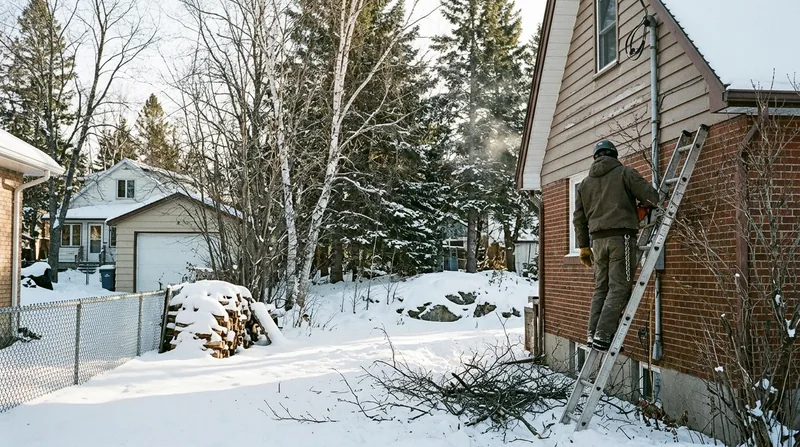




When the service wire from the street to your house runs through a canopy of silver maple or Norway spruce, the homeowner is usually responsible for keeping that span clear. Hydro line clearance in Thunder Bay is the work of trimming the private service entrance safely, in coordination with your electricity distributor, while leaving the public distribution network to utility crews. Our ISA Certified Arborists assess the span, the species, and the approach distances before any saw goes up. Ice storms, lake-effect snow, and summer windstorms all load these wires, and a branch that rubs through insulation can cut power to the whole house. We handle the private side of that equation, document the work, and leave the property clean. For the broader picture of what trimming covers, see our tree trimming service.
Why service wire clearance matters on older residential lots
Most post-war subdivisions in Thunder Bay were planted with fast-growing species that now reach the service drop. A silver maple that was a sapling in 1960 can push limbs into the wire every spring. The result is abrasion on the neutral conductor, sagging spans, and outages that start at the weatherhead rather than at the pole.
- Branches that contact the service wire wear the insulation and create a fire risk at the mast.
- Ice storm loading snaps weak limbs onto the drop and pulls the weatherhead away from the wall.
- Snow and wind push conifers such as Norway spruce into the span through the winter.
- Deferred trimming raises the cost because the tree must be removed rather than pruned back.
Clearing the span early protects the wire, the roof, and the household budget. The work is scheduled with the utility's clearance requirements in mind, never against them.
Key fact: A mature silver maple in a Westfort backyard can add 30 to 45 centimetres of growth per year on limbs that reach the service drop. Two seasons of deferred trimming often means a larger removal instead of a simple prune.
in Thunder Bay and the surrounding area's electrical safety regulator publishes homeowner guidance on staying clear of overhead lines and on who to call when a tree is touching the public supply. Read the Electrical Safety Authority guidance before you plan any work near a wire.
How our crews clear a private service span
Every job starts with a site walk and a look at the wire path from the pole to the weatherhead. We identify the species, measure the clearance, and check whether the tree can be pruned back to a sound lateral or must come down. The utility is contacted when the span or the meter base needs attention before we start.
- We confirm the service entrance location and mark the approach distances on the ground.
- We set up rigging so cut limbs lower away from the wire, the roof, and the fence line.
- We prune to a live lateral, respecting the species' growth habit and the clearance required.
- We chip the brush on site and rake the roof and gutters before we leave.
- We photograph the finished span and hand over a written summary for your records.
If the tree is beyond pruning, we coordinate the removal with the same care for the live wire. Homeowners in Oliver Paipoonge and Gillies can book the same process through our Oliver Paipoonge service page.
Key fact: On a ravine lot off a steep access in Thunder Bay, a 12-metre black locust leaning toward the service drop was pruned back 2.5 metres in a single morning. The crew rigged every limb away from the wire and left the slope stable.
Methods we use near a live service entrance
The method depends on the tree's position, the wire height, and the room to work. We choose the least invasive option that restores clearance and keeps the tree sound. Each technique is matched to the species and the site.
| Method | Description | Context |
|---|---|---|
| Directional pruning | Cuts back limbs to a live lateral away from the wire. | Mature maples and oaks with room to regrow. |
| Crown reduction | Lowers the crown height while keeping the form. | Spruce and birch crowding the drop. |
| Rigged removal | Lowers sections away from the wire and roof. | Trees that cannot be pruned to clearance. |
| Cabling and bracing | Supports weak unions on retained trees. | Heritage trees near the service span. |
| Brush chipping | Processes limbs on site and removes the debris. | Every job, to leave the yard clean. |
The right method is the one that restores clearance without destabilizing the tree. Our arborists explain the choice before the first cut.
What governs the work on private property
The City of Thunder Bay may require a permit for a private tree removal, and the application is normally supported by an arborist report. Rules and thresholds differ from one municipality to the next across the Thunder Bay area, so we confirm the local requirement before scheduling a removal. Approach distances near the private service entrance are respected at all times, and any tree touching the public distribution network is referred to your local utility or Hydro One. We never work on the public supply.
Residue is chipped and hauled away, and the roof and gutters are cleared of debris. When a removal needs municipal review, our arborist report service supplies the documentation the application requires. Homeowners who want the full scope of the site can review our pricing page before booking a visit.
When to schedule clearance in the Thunder Bay area
Trimming and structural pruning are best done in dormancy, from late fall to late winter, when the canopy is bare and the wire path is visible. Cedar hedge trimming fits late spring and summer, and emerald ash borer injection runs from late spring to early summer. Emergency removals happen year-round and peak with ice storms and summer windstorms.
- Book dormant pruning between November and March for the cleanest cut and the least stress on the tree.
- Inspect the service drop after every ice storm or windstorm before the next forecast.
- Schedule ash work before the injection window closes in early summer.
- Call for an emergency assessment when a limb is resting on the wire or the weatherhead is pulled loose.
A short inspection in late fall prevents most winter outages on the private span. Our emergency tree removal page covers the after-hours process when a storm has already done damage.
Working safely around the private service entrance
Our crews treat every service wire as live until the utility confirms otherwise. We maintain the required approach distances, use non-conductive rigging where the span demands it, and stop work if the wire or the mast shows damage. The homeowner receives a written summary of the clearance achieved and any follow-up the utility needs to handle.
Documentation matters when a storm claim follows. We photograph the finished span and the surrounding trees so your insurer has a clear record of the condition at the time of service. For a free estimate on your property, call (807) 699-7871 or use our contact page.
Prices Hydro Line Clearance in Thunder Bay — Indicative pricing
| Service | Price | Details |
|---|---|---|
| Service wire clearance prune | From $275 | Directional pruning of limbs reaching the private service drop. |
| Crown reduction near the span | From $450 | Height reduction on spruce, birch or maple crowding the wire. |
| Rigged removal at the service entrance | From $850 | Sectional removal when pruning cannot restore clearance. |
| Cabling and bracing on a retained tree | From $375 | Support for weak unions near the service span. |
| Travel | Included | In Thunder Bay and the surrounding municipalities. |
| Estimate | Free | Reply within 24 hours at (807) 699-7871. |
Indicative prices; free, personalized estimate within 24h at (807) 699-7871.