



Thunder Bay's northern climate puts real pressure on trees: late-spring frosts, freeze-thaw cycles that split bark, wet clay that holds water against the roots, and thin soil over rock on ravine lots. Tree disease treatment in Thunder Bay starts with an honest diagnosis, because a silver maple with slime flux, a birch with leaf spot and a spruce with needle cast need three different responses. Our ISA Certified Arborists inspect the crown, trunk and root flare, identify the pathogen or the site problem, and recommend treatment only where it will change the outcome. We have worked the Thunder Bay area since 2020, from mature street trees in post-war subdivisions to cedar hedges on nearly every property line. If you are comparing companies, start with our complete pricing guide so you know what a site visit and a treatment plan should cost.
Why a diagnosis matters more than a spray
Most tree problems in Thunder Bay are not caused by a single disease. They come from a combination of winter injury, poor soil drainage and chronic drought stress that leaves the tree open to secondary pathogens. A fungus on a leaf is often a symptom, not the cause. Our arborists confirm what is actually killing the tree before recommending anything, and they tell you when removal is the safer, cheaper option.
- We inspect the root flare and soil to separate root stress from infection.
- We identify common in Thunder Bay and the surrounding area pathogens such as tar spot on maple, anthracnose on oak and birch leaf spot.
- We check for emerald ash borer galleries under the bark of every ash on the property.
- We assess structural damage from ice storms and summer windstorms before treating anything.
That sequence protects your budget: you pay for treatment only when the tree can recover.
Key fact: A soil test and a root-flare inspection on a mature silver maple in Westfort typically take 45 to 60 minutes. That visit is included in our free estimate, and it often saves homeowners the cost of a treatment that would not have worked.
For reference on invasive pests and regulated species, consult the Canadian Food Inspection Agency emerald ash borer page.
How our arborists diagnose and treat
We follow the same four-step process on every property in the Thunder Bay area, whether it is a single birch in Gillies or a row of mature oaks along a ravine lot. The goal is a written finding you can act on, not a sales pitch for a spray program.
- We walk the property and record species, crown condition and site drainage.
- We take samples where needed and identify the pathogen or the abiotic cause.
- We recommend a treatment, a pruning prescription or removal, with costs in writing.
- We schedule follow-up inspections to confirm the tree is responding.
Each step is documented, so you have a record for your own files or for a permit application.
Key fact: On a ravine lot in Oliver Paipoonge, we diagnosed a red oak with crown dieback as root stress from clay soil, not a fungal infection. Corrective pruning and a mulch ring cost far less than the fungicide program the homeowner had been quoted elsewhere.
When the diagnosis points to a structural problem rather than a pathogen, we move to tree cabling and bracing to support weak unions while the tree recovers.
Treatment methods we use
Not every disease can be cured, and we say so. The methods below are the ones that produce measurable results in northern in Thunder Bay and the surrounding area conditions. We choose based on species, pathogen and site, never on what is easiest to sell.
| Method | Description | Context |
|---|---|---|
| Corrective pruning | Removes dead, diseased and crossing limbs to restore airflow and light. | Crown dieback, cankers, storm damage. |
| Fungicide injection | Targeted application into the vascular system under pressure. | Selected leaf diseases and vascular wilts. |
| Emerald ash borer injection | Trunk injection timed to the insect life cycle. | Ash trees still showing a healthy crown. |
| Soil and root-zone treatment | Aeration, mulch and drainage correction around the root flare. | Clay soil, compaction, wet ground. |
| Sanitation removal | Removal of infected wood and chipping of debris. | Cankers and fire blight on fruit trees. |
We match the method to the diagnosis and explain the expected result before any work begins.
What the City of Thunder Bay requires
Before any work starts, we check what applies to your property. The City of Thunder Bay may require a permit for a private tree removal, and the application is normally supported by an arborist report. Rules and thresholds differ from one municipality to the next across the Thunder Bay area, so we confirm the local requirement rather than assume it. Near private electrical service entrances, we respect the required approach distances, and any tree touching the public distribution network is referred to your local utility or Hydro One. We never work on the public distribution network itself. Diseased wood and brush are chipped or removed from site, and we leave the property clean.
When a permit application needs supporting documentation, we prepare the arborist report that describes the tree's condition and the reason for the proposed work.
When to call for treatment
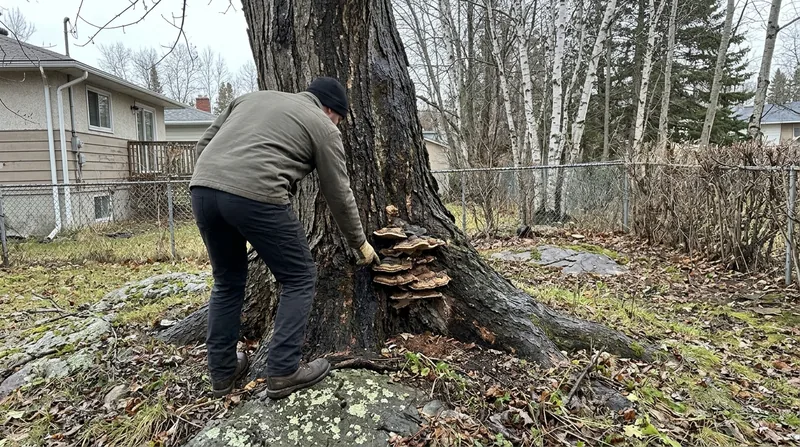
Timing depends on the disease and the species. Trimming and structural pruning are best done in dormancy, from late fall to late winter, when the tree's energy is in the roots and wounds close cleanly in spring. Cedar hedge trimming runs in late spring and summer. Emerald ash borer injection is scheduled from late spring to early summer, when the insect is active. Emergency removals happen year-round and peak with ice storms and summer windstorms. If you see thinning crowns, early leaf drop or shelf fungi at the base, call before the next season.
For a free estimate, contact us at (807) 699-7871 or visit our contact page. We serve Thunder Bay, Oliver Paipoonge and Gillies, and we will tell you honestly whether treatment, pruning or removal is the right call.
Prices Tree Disease Treatment in Thunder Bay — Indicative pricing
| Service | Price | Details |
|---|---|---|
| Diagnostic visit and written findings | From $175 | Species identification, root-flare inspection and written recommendations |
| Corrective pruning for disease | From $350 | Removal of dead and diseased limbs, debris chipped and hauled |
| Fungicide injection | From $425 | Targeted trunk injection for selected leaf diseases and wilts |
| Emerald ash borer injection | From $375 | Per ash, timed to the late-spring to early-summer window |
| Soil and root-zone treatment | From $300 | Aeration, mulch ring and drainage correction around the root flare |
| Free estimate | Free | On-site assessment, response within 24 hours at (807) 699-7871 |
Indicative prices; free, personalized estimate within 24h at (807) 699-7871.