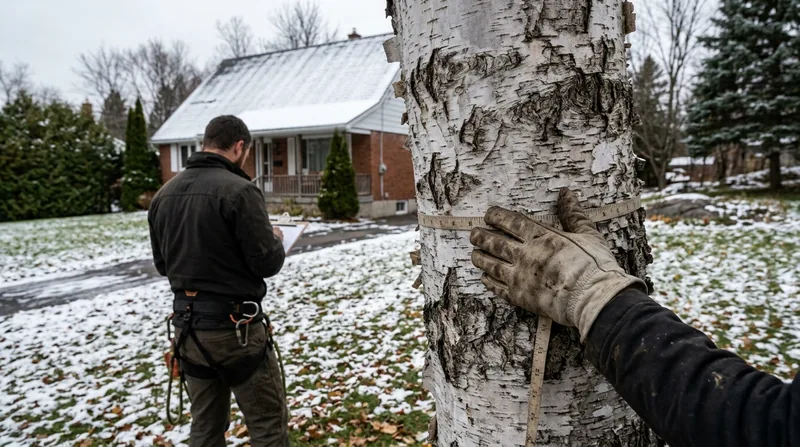




Property owners across the Thunder Bay area need written proof about the condition of their trees more often than they expect. A mature silver maple leaning over a proposed addition, a row of ash killed by the emerald ash borer along a property line, or a ravine lot where steep access makes every decision costly: these situations call for an Arborist Report in Thunder Bay prepared by an ISA Certified Arborist. Our company has produced these assessments since 2020 for development files, construction near trees, insurance claims and property sales. The report gives you a tree inventory, condition ratings and protection recommendations you can hand to a builder, a lawyer or a municipal reviewer. If you are comparing companies, start with our tree removal service page to see how removals are handled once a report is complete.
Why a written tree assessment matters before you build or sell
Construction activity compacts soil, cuts roots and changes drainage. A report documents the trees worth keeping and the measures that protect them during excavation. Across Thunder Bay neighbourhoods with post-war housing stock, mature street trees and tight backyards create exactly these conflicts. A report also supports a private tree removal application when the City of Thunder Bay requires a permit.
- We inventory every tree on the lot with species, diameter and condition rating.
- We identify hazards such as deadwood, included bark and root damage.
- We recommend protection areas and pruning specifications for the contractor.
- We document emerald ash borer damage where ash trees are present.
- We provide a written record you can submit to your insurer after storm damage.
Each report closes with clear recommendations, so your builder or lawyer knows what must happen before work starts. For official guidance on tree protection during development, consult the Government of in Thunder Bay and the surrounding area forestry pages.
Key fact: A report for a typical residential lot in Westfort with 12 to 18 trees is usually completed within one week of the site visit, and the written document runs 8 to 15 pages depending on the number of trees and the complexity of the proposed work.
How we prepare your arborist report
Every file follows the same sequence, whether the property sits on a ravine lot or in a dense subdivision. We start with a site visit, gather field data, then produce the written document. Our ISA Certified Arborists sign the report, which matters when a reviewer or an insurer asks who stands behind the findings.
- We review your plans, survey or listing documents before the visit.
- We walk the property and tag each tree, recording species, size and condition.
- We assess root areas, soil compaction risk and access constraints for equipment.
- We photograph defects and measure distances to proposed structures.
- We draft the report with a tree inventory table, condition ratings and protection recommendations.
- We deliver the signed document and answer follow-up questions from your contractor or reviewer.
The finished file is practical: it tells your contractor where to fence, where not to park machinery and which trees should be removed before construction begins. Where a removal is recommended, our stump grinding service handles the remaining material on the same site.
Key fact: On a lot in Oliver Paipoonge where a new garage was planned within 4 metres of a 60 cm sugar maple, the report recommended a root protection zone and a pier foundation design; the tree stayed and the project passed review without redesign.
Report formats and when each one applies
Not every file needs the same document. A property sale may require a short condition statement, while a development application usually needs a full inventory with protection plan. We match the format to the purpose so you do not pay for detail you will never use.
| Method | Description | Context |
|---|---|---|
| Visual tree assessment | Ground-level inspection of each tree with species, size and condition rating. | Property sales, insurance files, general risk review. |
| Tree protection plan | Inventory plus root protection areas and construction recommendations. | Renovations, additions, new builds near mature trees. |
| Hazard and risk report | Detailed defect analysis with target assessment and mitigation options. | Storm-damaged trees, leaning maples, deadwood over structures. |
| Pre-removal assessment | Species, size and condition statement supporting a permit application. | Private tree removal where the City of Thunder Bay requires a permit. |
| Emerald ash borer assessment | Ash identification, canopy decline rating and treatment recommendation. | Ash trees on residential lots and along property lines. |
Choosing the right format at the start avoids a second visit and keeps your timeline intact. If your project involves a hedge along a boundary, our cedar hedge trimming service page covers the maintenance side once the report is filed.
Permits, clearances and site rules in the Thunder Bay area
Municipal rules differ from one municipality to the next, and the City of Thunder Bay may require a permit for a private tree removal. An arborist report normally supports that application, and we prepare the document in a format reviewers can use. Rules and thresholds also vary in Oliver Paipoonge and Gillies, so we confirm the local requirement before the site visit.
Safety distances matter near private electrical service entrances. Our crews respect approach distances around the wire that runs from the pole to your house. Trees touching the public distribution network are referred to your local utility or Hydro One; we never work on that network. Debris from any recommended pruning or removal is chipped and hauled away, and we leave the property clean. For a site where brush and limbs accumulate, see our brush chipping service.
What the report costs and how to book a visit
Fees depend on the number of trees, the purpose of the document and access to the property. A short condition statement for a property sale costs less than a full protection plan for a development application. Ravine lots with steep access take longer to assess and are quoted after a site visit.
- Simple condition statement for a sale: from $350.
- Tree protection plan for a renovation or new build: from $650.
- Hazard and risk report: from $550.
- Pre-removal assessment supporting a permit application: from $400.
- Emerald ash borer assessment for multiple ash trees: from $450.
Every quote is free and confirmed in writing before we start. Call (807) 699-7871 to arrange a visit, or review the pricing page for the full fee structure. Our contact page lists the details we need to schedule your assessment.
Prices Arborist Report in Thunder Bay — Indicative pricing
| Service | Price | Details |
|---|---|---|
| Condition statement for a property sale | From $350 | Short written assessment with tree inventory and condition ratings |
| Tree protection plan for development | From $650 | Inventory, root protection areas and construction recommendations |
| Hazard and risk report | From $550 | Defect analysis with mitigation options for storm-damaged or leaning trees |
| Pre-removal assessment | From $400 | Species and condition statement supporting a permit application |
| Emerald ash borer assessment | From $450 | Ash identification, decline rating and treatment recommendation |
| Travel | Included | In Thunder Bay and the surrounding area |
| Quote | Free | Reply within 24 hours at (807) 699-7871 |
Indicative prices; free, personalized estimate within 24h at (807) 699-7871.