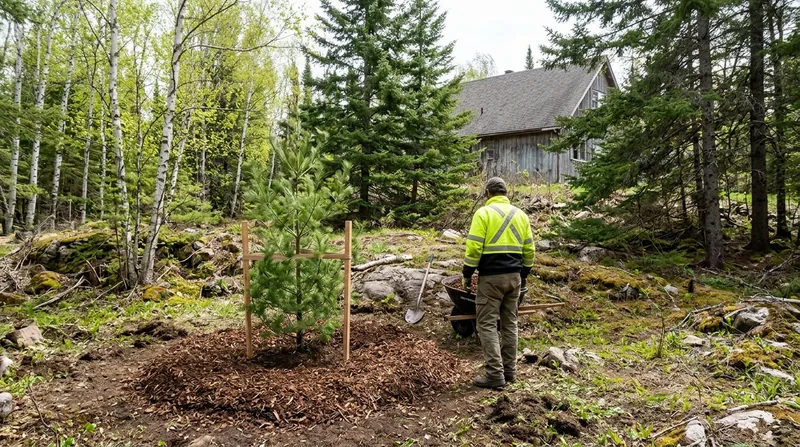




Choosing the right tree for a yard in Thunder Bay is a decision that lasts decades. The city sits in a cold, short growing season where silver and sugar maple, red and white oak, birch and Norway spruce do well when they are planted at the correct depth and given room to mature. Our Tree Planting & Transplanting in Thunder Bay service starts with the site, not the nursery catalogue: soil, drainage, overhead clearance, distance from the foundation and the private service entrance all shape what goes in the ground. We are a local, fully insured company with ISA Certified Arborists on staff, and we have planted and moved trees across the Thunder Bay area since 2020. Whether you are replacing an ash lost to the emerald ash borer or adding a specimen tree to a ravine lot, the goal is the same: a tree that establishes quickly and stays healthy. For background on how we assess existing trees before a planting plan, see our tree pruning service.
Why correct planting matters more than the tree you buy
Most transplant failures in this region trace back to the planting hole, not the nursery stock. A tree set too deep, in compacted clay, or staked for years will struggle through its first drought and its first freeze-thaw cycle. In Thunder Bay, where lake effect snow and spring melt move a lot of water through residential lots, drainage and root flare depth decide whether a young tree thrives or declines. The right species in the right place also reduces future maintenance and the risk of conflicts with structures and wires.
- We match species to your soil, light exposure and available root space before anything is ordered.
- We plant at the correct depth with the root flare visible and the graft union above grade.
- We amend only where soil tests or visible conditions call for it, rather than routinely.
- We stake only when the root ball or exposure requires it, and we plan the removal date.
- We water and mulch at installation and leave you a simple aftercare schedule.
Each of these steps is recorded on site so the same standard applies whether the job is in Westfort or on a rural property in Gillies. For a broader look at how we handle established trees, our tree trimming page covers structural work in dormancy.
Key fact: A 2 metre Norway spruce planted too close to a driveway in Oliver Paipoonge will need removal within 15 years. Moving the same tree 4 metres further out at planting costs a fraction of that future removal.
Municipal guidance on tree protection and planting near public infrastructure is published by the Government of in Thunder Bay and the surrounding area, and it is worth reading before you finalize a layout.
How we plant and transplant, step by step
Every planting job follows the same sequence, from the first walkthrough to the aftercare handover. The steps below apply to new plantings and to transplants moved with a full root ball. On tight lots in Thunder Bay neighbourhoods, access through a standard gate often dictates the equipment we use, so the plan is set before the crew arrives.
- We walk the site with you and confirm the planting locations, sight lines and underground services.
- We check soil texture and drainage, and we choose species suited to the exposure and the space.
- We dig the hole to the correct width and depth, and we scarify the sides where the soil is compacted.
- We set the tree, backfill in stages and water to settle the soil around the root ball.
- We install mulch, stake only if needed, and record the date for stake removal.
- We leave a written watering and monitoring schedule for the first two seasons.
The same discipline applies to transplants: root balls are lifted and moved with adequate soil volume, and the new location is prepared before the tree is lifted. For work on neighbouring properties, our Oliver Paipoonge service page explains how we coordinate access.
Key fact: A 60 mm caliper sugar maple transplanted in late April in the Thunder Bay area needs roughly 20 litres of water per week through its first summer. Skipping two weeks in July is the most common cause of transplant loss we see.
Methods we use for new trees and transplants
The method depends on the size of the tree, the access and the season. The table below sets out the options we use most often in the Thunder Bay area, with the situations where each one fits.
| Method | Description | Typical use |
|---|---|---|
| Bare-root planting | Tree supplied without soil around the roots, planted in early spring while dormant. | Small deciduous stock, open lots, budget-conscious plantings. |
| Container and balled-and-burlapped | Tree supplied with a root ball, planted through the growing season with irrigation. | Larger specimens, street trees, visible front-yard plantings. |
| Transplanting with a full root ball | Existing tree lifted and moved to a prepared location on the same property. | Renovations, layout changes, trees in the way of construction. |
| Cedar and conifer screening | Spacing and planting depth set for a continuous hedge line. | Property lines, windbreaks, privacy on corner lots. |
We confirm the method and the timing with you before the tree is ordered, because the choice affects cost, survival and the aftercare schedule. Our pricing page shows how each option is quoted.
Permits, clearances and debris on local properties
Planting rarely needs approval, but the work around it does. The City of Thunder Bay may require a permit for a private tree removal, and the application is normally supported by an arborist report; the same principle applies when a transplant or a new layout affects a protected tree. Rules and thresholds differ from one municipality to the next across the Thunder Bay area, so we check before we cut or move anything. Approach distances must be respected near private electrical service entrances, and any tree touching the public distribution network is referred to your local utility or Hydro One. We do not work on the public network. Debris from planting and transplanting is chipped and removed, and reusable material can be left on site at your request.
Aftercare in the first two seasons
A newly planted tree needs water, mulch and monitoring, not fertilizer. In this climate, the first summer and the first winter decide establishment. We provide a written schedule and we are available to inspect the tree at the end of the first growing season. If a tree fails to establish, we assess the cause with you before recommending a replacement. For properties with mature trees that need structural work alongside new planting, our cabling and bracing service covers support for existing specimens. To arrange a site visit, call (807) 699-7871 or use our contact page.
Prices Tree Planting & Transplanting in Thunder Bay — Indicative pricing
| Service | Price | Details |
|---|---|---|
| Bare-root deciduous tree, 1.5 to 2 metres | From $225 | Supply and planting, spring only, aftercare sheet included |
| Balled-and-burlapped tree, 2 to 3 metres | From $475 | Supply, planting, mulch and staking where required |
| Transplant on the same property | From $650 | Root ball preparation, lifting and replanting, access permitting |
| Cedar screening, per linear metre | From $95 | Spacing, planting and initial watering plan |
| Site assessment and planting plan | From $150 | Species selection, layout and soil check, credited against the planting job |
| Free estimate | Free | Response within 24 hours at (807) 699-7871 |
Indicative prices; free, personalized estimate within 24h at (807) 699-7871.